Quick Summary
Understand subfloor water damage, how it differs from damaged flooring, and what to ask before drying, replacement or a new floor installation.
Subfloor water damage concerns the supporting layer below the floor you walk on. Replacing wet carpet, vinyl or wood flooring does not settle whether the subfloor beneath it is sound and ready for a new covering. A useful assessment separates damage to the finish, underlayment, structural panels and the framing below.
Some wet wood structural panels can remain serviceable after appropriate drying and evaluation. Others need repair or replacement because of their condition, contamination or the requirements of the next flooring system. Neither “it got wet” nor “the top feels dry” is enough to make that decision.
Subfloor, underlayment and finished flooring: what is the difference?
| Layer |
Role in the repair decision |
| Finished flooring |
The visible walking surface, such as carpet, wood or resilient flooring. Its appearance does not reveal every layer beneath it. |
| Underlayment |
A layer used beneath some finishes to provide a suitable installation surface or other product-specific function. It is not automatically the structural subfloor. |
| Subfloor |
The supporting floor layer. In many framed homes this includes plywood or oriented strand board, commonly called OSB. |
| Joists, beams and supports |
The framing below the subfloor. Damage here is a structural question, separate from replacing a floor covering. |
APA’s underlayment and subfloor guidance explains these roles and combination floor systems. Not every home has each layer shown above. Ask the assessor to identify your actual construction, including a concrete slab or multiple older flooring layers, before proposing work.
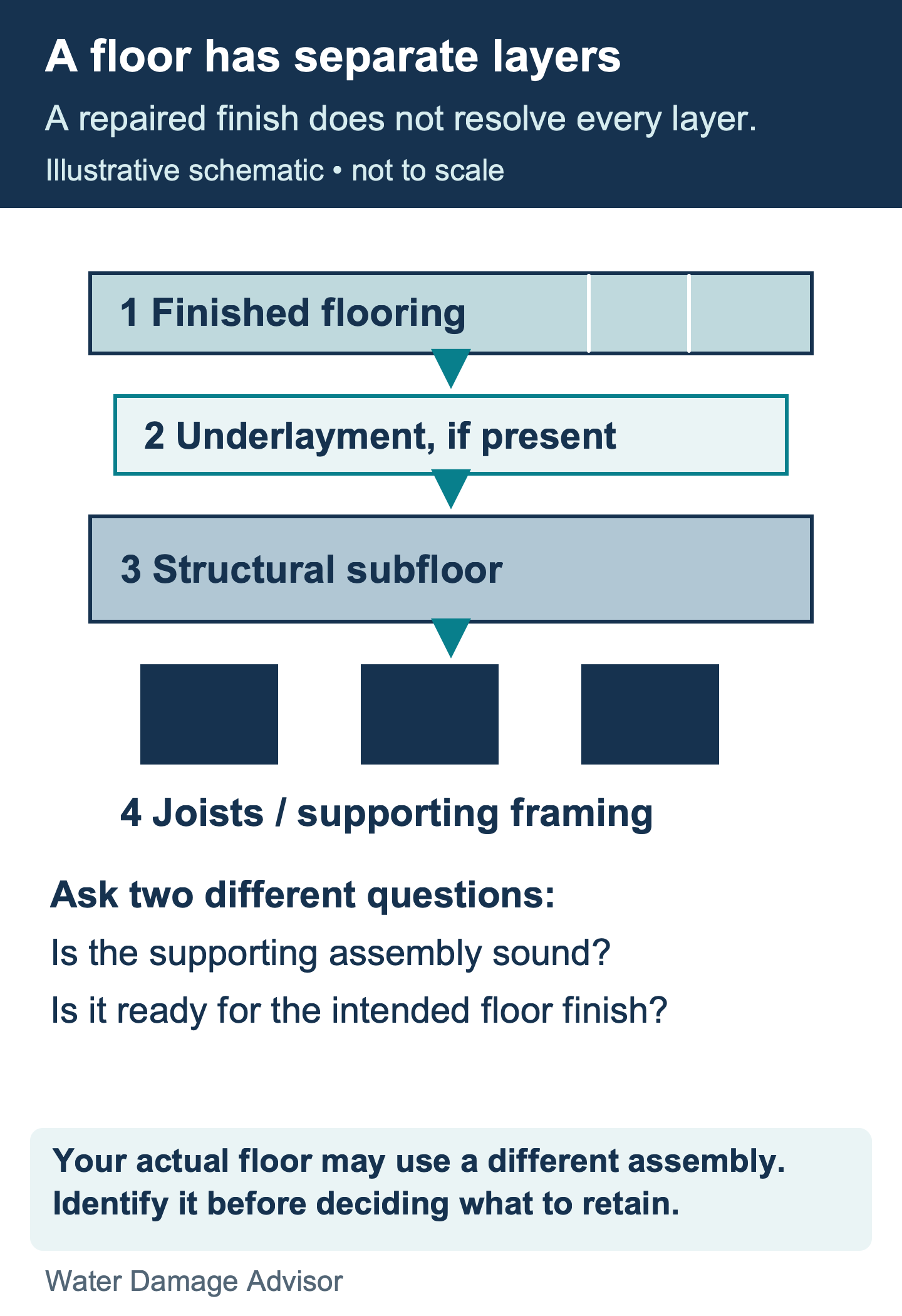 Illustrative layered floor assembly. Some homes combine layers or use a different construction. Identify the actual assembly before deciding what to retain, dry or replace.
What to do when you suspect subfloor water damage
Stop the known water source if that is safely possible and keep people away from a sagging, unstable or unusually soft floor. Do not jump, probe with a screwdriver or move a heavy appliance across the area to test its strength. If the floor may be structurally unsafe, arrange the appropriate building assessment before entering or loading it.
Record the leak, the visible damage and any changes in rooms below. Avoid lifting flooring or cutting inspection holes yourself when there may be electrical, structural or older-material hazards. See structural water damage for the questions to raise when movement or supports are involved.
Signs of subfloor water damage
Report new unevenness, changes at floor seams, loose finishes, persistent musty odor or staining visible on the underside from an already safe access point. A symptom can direct an investigation without proving which layer failed.
For example, a raised hardwood edge concerns the wood board but does not reveal the subfloor’s moisture condition. A lifted vinyl edge may expose only part of a larger wet area. Keep the observation separate from the proposed cause in your incident log.
Does a water-damaged subfloor have to be replaced?
APA’s guidance on moisture exposure explains that structural plywood and OSB can remain sound after wetting. It also calls for qualified evaluation after severe or unusually prolonged exposure. This construction-exposure guidance is not clearance for a sewage-contaminated floor, decayed framing or a particular finished floor installation.
Texas A&M AgriLife Extension’s flood recovery guidance identifies swelling and separation in submerged subfloors as reasons affected sections may need replacement before a new covering is installed. The differing contexts matter: a briefly rain-wet construction panel and an occupied home’s submerged, layered floor are not equivalent cases.
Ask the assessor to answer four questions:
- What material is it? Identify the panel or other substrate and its role. Do not apply structural-plywood advice to an unidentified underlayment.
- What reached it? Record the water source, known exposure history and contamination concerns.
- What condition remains? Describe separation, deterioration, fastening or support problems and whether the surface meets the next installation’s requirements.
- What supports the recommendation? Request the reason to retain or replace each affected area, including any need for a structural professional or manufacturer input.
A cosmetic surface change and lost structural capacity are different findings. Ask the contractor to name the actual concern rather than assuming all swelling proves structural failure or that structural adequacy guarantees a suitable flooring surface.
How should a wet subfloor be dried and checked?
The plan needs to reach the affected layers. Ask whether the finish or underlayment prevents assessment or drying and whether access from below is safe and useful. Removal may serve several purposes: dealing with unsalvageable material, exposing trapped moisture or establishing the condition of an uncertain area. Have the reason documented before demolition.
Do not use an arbitrary number of days or an unexplained meter reading to decide that the whole floor is ready. Request a map or photographs of the measurement locations, the material tested, the instrument and method used, the comparison or target and the changes over time. The flooring installer should explain the product-specific acceptance requirements for the intended installation.
Keep wood and concrete assessment methods distinct. A surface reading through a finish is not a substitute for the method the substrate and flooring manufacturer require. For damp framing or insulation below a raised floor, include the crawl space and wet insulation findings in the same handoff.
What should subfloor replacement include?
A written proposal should identify the affected area, floor layers to be removed, disposal, underlying repairs, replacement material and responsibility for the finished floor. Ask how panel edges and other affected connections will be supported and who determines the required construction details. Those are job-specific repair decisions, not a standard cut-and-patch diagram.
Resolve cabinets, fixtures, transitions and access before accepting a partial-floor price. For concealed damage, agree on how findings and additional charges will be documented and approved. Compare equivalent work using the restoration quote worksheet.
Before the floor is covered again
- The source repair is recorded, with any remaining limitation explained.
- Retained and replaced layers are identified, including the space beneath the floor.
- Contamination, deterioration and structural questions have a documented resolution.
- The installer has accepted the substrate conditions required for the new flooring.
- Photographs, measurements, product information and responsible contacts are saved.
These are handoff questions, not a homeowner certification of structural safety or dryness. Keep an unanswered item visible until the person responsible resolves it.
Common subfloor water damage questions
Can the floor covering be saved while the subfloor dries?
Sometimes a proposal may retain a finish, but it needs to explain how the layers beneath will be assessed and dried. The answer depends on the installed assembly, water event and product requirements. Consult the separate hardwood damage or carpet damage guide for finish-specific questions.
Will a stain disappear when the subfloor is dry?
Appearance is not a reliable completion test. Keep photographs as part of the record, but request the assessment and installation-readiness evidence rather than relying on stain color.
How much does subfloor water damage repair cost?
Ask for separate prices for access, removal, substrate repair and finish replacement. A square-foot price without those boundaries cannot establish the total. Our water damage restoration cost guide explains comparison questions.
Explore the related assessment
Sources and further reading
For source identification and the wider response, return to the water damage guide.