Quick Summary
Print a drying-record worksheet to organize material readings, instrument details, comparison points and unresolved questions before repairs cover the area.
Use this drying-record worksheet to organize the findings a contractor gives you before repairs cover affected materials. Print the page or copy the fields into your own notes. Keep completed records privately with your repair documents.
A drying record should help you understand what was checked, what changed and what still needs attention. Use this worksheet to discuss the contractor’s findings. You do not need to perform the testing yourself.
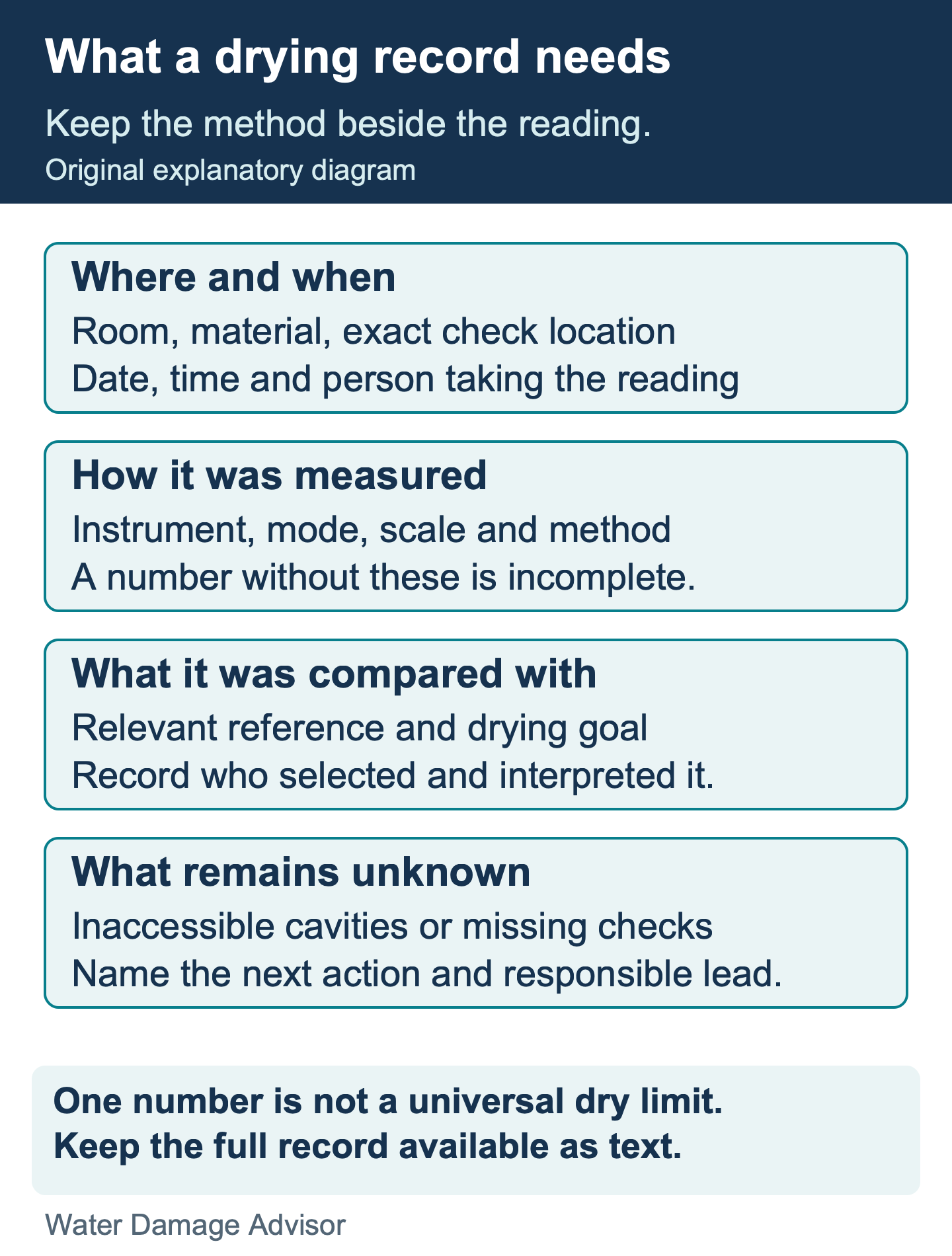 Illustrative record anatomy, with no fabricated readings or universal drying threshold. Use the adjacent blank record for actual observations.
What the record should identify
Ask for repeatable locations, such as a marked point beside a doorway, rather than just “bedroom wall.” Record the material and which layer was assessed. Painted drywall, framing and insulation are different parts of the wall.
For each reading, ask for the instrument model, mode or scale, units, date and time. The record should explain the reference used for comparison, why it is appropriate, and whether later checks used a comparable method. Include the technician’s name, findings, inaccessible areas and next decision. Photographs can help connect a measurement to its location.
These fields are a communication aid, not a prescribed industry form or a guarantee that the assessment is sufficient.
Why one number is not enough
A meter number needs its measurement method attached. For example, the Tramex MEX5 Drywall-Roofing scale gives comparative readings, not percentage moisture content or relative humidity. Its manual describes comparison with a known-dry reference. That does not make any particular reading a universal “safe to close” number. Other instruments and modes require their own instructions. MEX5 manual, comparative scales and baseline-reference sections
This model also cannot measure through electrically conductive materials such as metal sheeting, and its manual identifies other limitations. Ask whether the material, surface or concealed layers limit the result. A room-air reading answers a different question from a material reading.
Likewise, equipment running for several days records activity. Completion requires findings about the affected materials. EPA cautions against sealing flooded cavities or applying finishes before the materials are dry inside. EPA flood cleanup guidance
Blank record to discuss with the assessor
Use one copy for each location and check. Write unknown or not assessed instead of leaving an uncertainty looking resolved.
| Record field |
Entry |
| Date, time and assessor |
____________________ |
| Room, marked location and photo reference |
____________________ |
| Material/layer assessed |
____________________ |
| Water source and source-repair status |
____________________ |
| Instrument model, mode/scale and units |
____________________ |
| Result and relevant room conditions |
____________________ |
| Comparison/reference and why it fits |
____________________ |
| Cavity or other layers assessed, and how |
____________________ |
| Limits, inaccessible areas or unknowns |
____________________ |
| Change since prior check |
____________________ |
| Next action, reason and responsible person |
____________________ |
Illustrative example: a missing cavity observation
This is a constructed example, not a real job or measurement.
An entry says the living-room wall surface appears drier than at the previous check. It does not identify whether the insulation or framing behind that surface was assessed.
That entry leaves a question open. Ask: “What evidence addresses the cavity, and what remains unknown?” The assessor should explain whether further investigation is needed and how it can be done safely. The missing entry alone does not prove that the cavity is wet or that demolition is necessary.
Questions before closing or finishing a wall
- Has the moisture source been corrected?
- Which affected layers have been assessed, and which remain inaccessible?
- What findings support keeping the materials and covering them now?
- Are contamination, damaged material or hidden mold still unresolved?
- Who records the decision and any follow-up?
EPA’s clean-water guidance allows some intact drywall to dry in place but identifies the cavity as particularly difficult to dry. Contaminated water requires a different assessment. EPA material guidance
Safe access, hidden contamination, hazardous older materials and the need to open a cavity require onsite assessment. Do not cut or probe a wall simply to complete this worksheet. Keep the findings and unresolved questions with your repair records.
Keep repeat checks comparable
Give each location a simple identifier and keep the same identifier in photographs and later records. If the instrument, scale, access or assessed layer changes, ask the assessor to explain what can still be compared. A blank field means information is missing, not that the condition passed a check.
Store the source repair, removed-material decisions, retained-material findings and unresolved items together. Ask who will check an unresolved item and when. The worksheet organizes a conversation. It does not replace the actual assessment or create an industry certification.
Use the record with the right guide
Sources and further reading